

Drive-In Racking vs. Shuttle Racking vs. Mobile Racking: What's the Difference?
Choosing the right warehouse racking system involves far more than storage capacity. Inventory type, daily operational needs, available space, and budget are all key factors that must be considered.
Drive-in racking, shuttle racking, and mobile racking are three common solutions for high-density storage. While they are similar in terms of space savings, their operation and suitable applications differ significantly. Let's look at the characteristics of each system and what kind of warehouse environment each is best suited for.
1. Drive-In Racking

Drive-in racking is designed for storing large quantities of similar products. Forklifts can drive directly into the racking aisles to load and unload pallets, so fewer aisles are needed between rack rows.
This system generally follows Last-In, First-Out (LIFO), making it suitable for warehouses with longer shelf life or where strict First-In, First-Out (FIFO) management is not required.
Key features:
High storage density with fewer aisles required.
Suitable for bulk storage with a small number of SKUs.
Relatively low investment cost.
Requires forklifts to enter the racking aisles.
Typical applications: cold storage, food warehouses, and bulk inventory storage.
2. radio shuttle racking systems
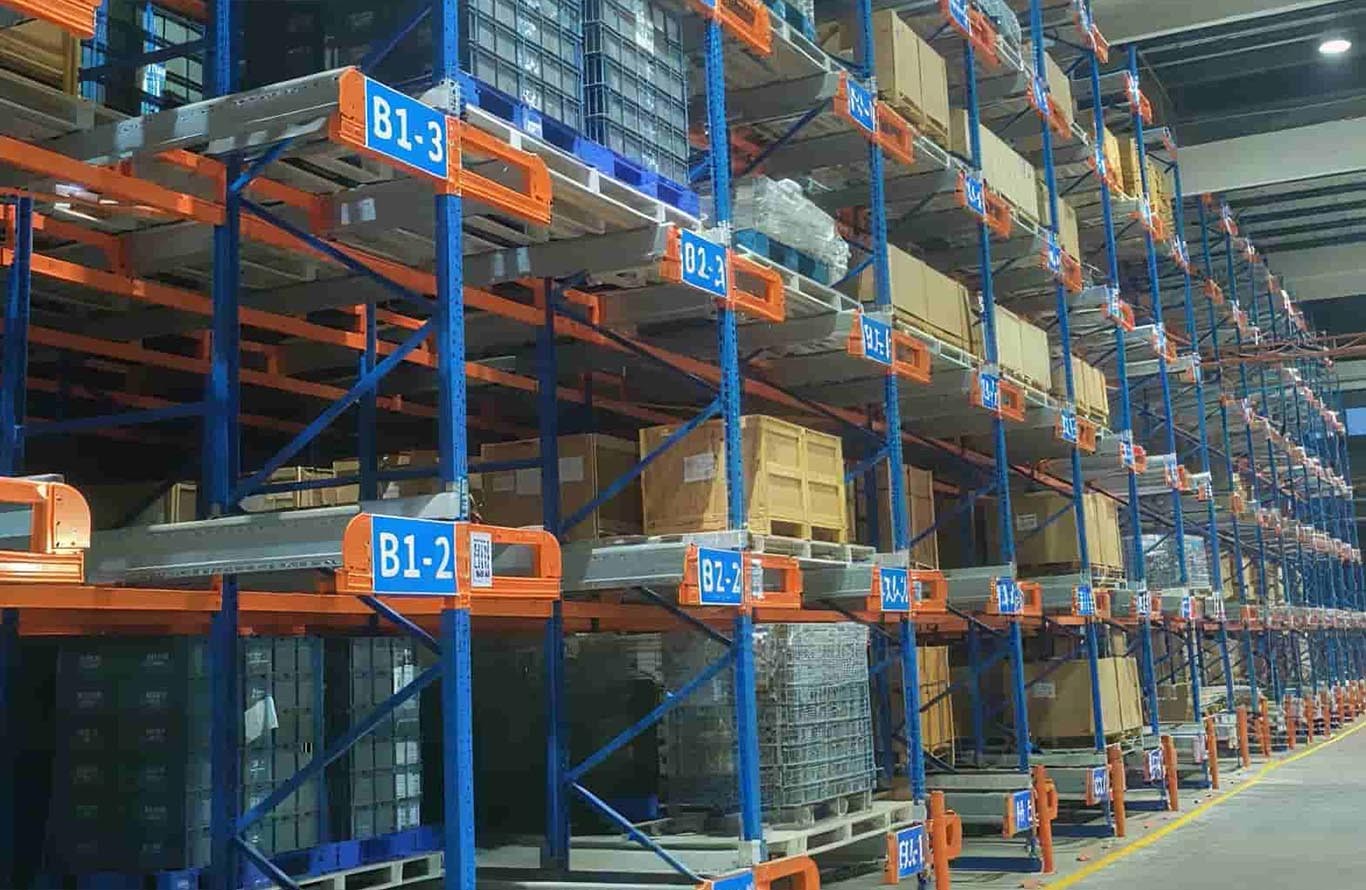
Shuttle racking uses battery-powered shuttle carts to move pallets along rails inside the racking. Forklifts only need to load and unload pallets at the rack entrance and do not enter the storage aisles.
The shuttle carts are controlled by remote control or a Warehouse Management System (WMS). Depending on the layout design, the system supports both FIFO and LIFO modes.
Compared with drive-in racking, shuttle racking reduces forklift travel distance and improves pallet handling efficiency. It is particularly suitable for warehouses with frequent access operations.
Key features:
Semi-automated pallet handling.
Supports both FIFO and LIFO configurations.
Reduces forklift travel inside racking aisles.
Higher investment cost than traditional drive-in racking.
Typical applications: food processing, cold storage, manufacturing, and distribution centers.
3. Mobile Racking

Mobile racking is mounted on motorized bases and moves along tracks on the warehouse floor. Instead of requiring a fixed aisle between every rack row, it dynamically opens an aisle where needed based on access requirements. This system can accommodate more racking in the same warehouse space while ensuring every pallet position is independently accessible.
Mobile racking is particularly suitable when warehouse space is limited and goods do not require frequent access.
Key features:
Extremely high space utilization.
Supports independent access to individual pallets.
Electrically operated with safety controls.
Higher initial investment and certain maintenance requirements.
Typical applications: cold storage, pharmaceutical warehouses, and warehouses with limited floor space.
4. Key Differences Between the Three Systems
| Comparison Dimension | Drive-In Racking | radio shuttle racking systems | Mobile Racking |
|---|---|---|---|
| Storage density | High | High | Very high |
| Storage method | Mainly LIFO | FIFO / LIFO | Independent access |
| Operating speed | Medium | Fast | Medium |
| Investment cost | Low | Medium to high | High |
| Automation level | Low | High | Medium |
| Suitable scenarios | Bulk storage | Frequent pallet handling | Space saving |
Actual storage capacity and investment cost depend on warehouse dimensions, pallet specifications, racking height, and system configuration.
5. Which Racking System Should You Choose?
No single solution fits all warehouses. The best choice depends on your core needs.
If you need to store large quantities of similar products and want to control equipment costs, choose drive-in racking.
If you need higher storage density, faster pallet handling, and want to reduce forklift operations, choose shuttle racking.
If warehouse space is limited and you need to access each specific pallet position, choose mobile racking.
For warehouses with multiple storage needs, these systems can also be combined within the same facility.
6. Looking for a Warehouse Racking Manufacturer?

HLD Shelves has been manufacturing warehousing and logistics equipment in China since 2001. We provide customized storage solutions, including drive-in racking, shuttle racking, mobile racking, selective pallet racking systems, and other warehousing systems.
From warehouse layout planning to racking manufacturing, our team can recommend the most suitable solution based on your available space, pallet dimensions, storage capacity, and operational needs.
Contact HLD Shelves to discuss your project requirements and get a customized warehouse racking solution.
FAQ
Q1: Which racking system offers the highest storage density?Mobile racking typically provides the highest space utilization because it eliminates most fixed aisles. However, actual results depend on the specific warehouse layout.
Q2: Is shuttle racking better than drive-in racking?Shuttle racking handles pallets more efficiently and reduces forklift movement. Drive-in racking has a simpler structure and is usually lower in cost. Which is better depends on your specific operational needs and budget.
Q3: Can different racking systems be used in the same warehouse?Yes. For example, drive-in racking can be used for large quantities of similar inventory; shuttle racking for frequently moving pallets; and mobile racking for storing goods with lower access frequency.
