Welcome to HLD Shelves Company. We provide customized storage shelving solutions and look forward to hearing from you.

Warehouse Storage Racking | HLD Shelves
Warehouse Storage Racking

Engineered around your pallet dimensions, per-level load capacity, and clear height.

​Gravity flow racking

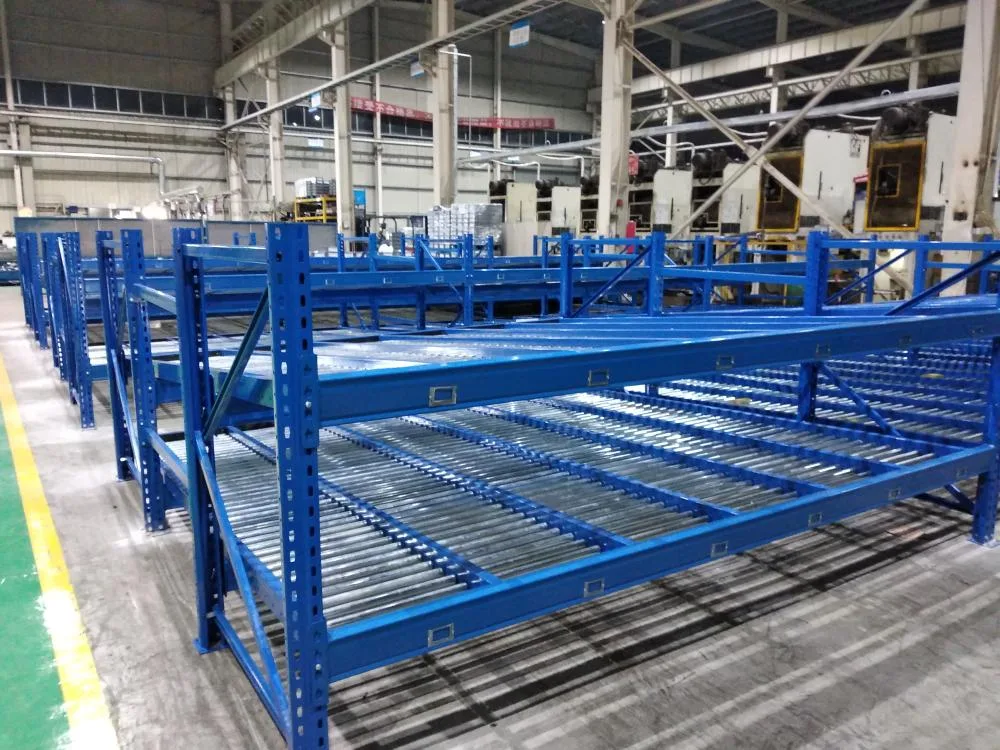
​Gravity flow racking, also known as"FIFO"(First In, First Out) racking, is a type of storage system that uses gravity to move products from the loading side to the picking side.
Send Inquiry

Specifications

Figures below are the standard range for this system. Final values are confirmed per project after pallet sizes, load per pallet and clear height are reviewed.

Design basisEN 15512 structural principles, FEM 10.2.02; load capacity verified per project
Description
Products Description

Gravity flow racking, also known as"FIFO"(First In, First Out) racking, is a type of storage system that uses gravity to move products from the loading side to the picking side. It is often used for inventory management in environments where products need to be rotated regularly, such as in food distribution, pharmaceuticals, or retail.


In this system, items are loaded onto inclined shelves, and as new products are added, older products naturally move forward and are picked first. This reduces the risk of stock aging or expired products, ensuring the freshest items are always picked first.


Specifications:


AttributeSpecification/Details
MaterialHigh-strength steel frame with either steel or plastic rollers/wheels for the tracks
Track TypeRoller tracks or wheel tracks depending on the size and weight of the products
Load CapacityLight-duty (up to 500 kg per level), heavy-duty (up to 1,000 kg per level)
Rack HeightTypically ranges from 2m to 6m, customizable based on the available vertical space
Rack DepthTypically between 600mm to 1,200mm, adjustable to the required product size
Incline/GradientTypically between 3° to 6°; adjustable to suit specific products and operational needs
Shelf SizeCustomizable to accommodate various product sizes, from small boxes to large pallets
ConfigurationSingle-deep, double-deep, or multi-deep layouts depending on the space and product type
Safety FeaturesAnti-slip rails, load dividers, and safety barriers to control the flow of products
Custom FeaturesAdjustable track lengths, dividers, and end stops to fit specific product types and needs


Key Features of Gravity Flow Racking:

FIFO (First In, First Out):Ensures products are rotated and older stock is used before newer stock.

Gravity-driven: Uses the slope of the racking system to move products forward without the need for powered conveyors.

Space-efficient: Maximizes storage density while maintaining easy access to items.

Versatility: Suitable for handling a wide variety of products, including pallets, boxes, and totes.


Advantages:

Efficient use of space: High-density storage that reduces aisle width requirements.

Improved inventory control: Simplifies product rotation and reduces the chances of inventory becoming obsolete or expired.

Time-saving: Makes picking more efficient by ensuring the first items placed are the first to be picked.


Gravity flow racking


Gravity flow racking

Frequently asked questions

What load can each level carry?

Capacity is engineered per project, because it depends on the beam span, the upright section and how the pallet sits on the beams. For this product range the standard figure is 500–4,000 kg per level; anything outside that range is calculated case by case. Send us the pallet size and load per pallet and we will confirm the figure for your bay.

Can beam levels be adjusted after installation?

Yes. Beams sit in punched slots along the upright, normally on a 50 mm pitch, so a level can be moved without replacing the frame. The load rating has to be re-checked against the new span before the level is reloaded — never change a beam position without confirming the capacity for that configuration.

Which standards is the system designed to?

Design follows the principles of EN 15512 (steel static design) and FEM 10.2.02, with tolerances and clearances taken from EN 15620 and inspection/maintenance guidance from EN 15635. For North American projects we work to RMI/ANSI MH16.1. Load capacities are verified for each project rather than published as a single blanket rating.

Do you provide layout drawings and load calculations?

Yes. Send the floor plan (or just overall dimensions), pallet size, load per pallet, required number of positions and available clear height. We return a 2D layout, a 3D view and a beam load table with the quotation, so you can check the design before ordering.

What is the lead time and how is it shipped?

Standard bays are produced in about 15–25 days after drawing approval; large multi-phase projects are scheduled by delivery phase. Racking ships knock-down in containers, FOB or CIF, with marked bundles, installation drawings and an anchor bolt plan included.

Can the racking be extended later?

Yes. It is a bolted modular system: new bays can be added at either end of a row, and existing uprights accept additional beam levels. Expansion keeps the same upright and beam sections, so the added structure matches the original installation.

Designed & manufactured to
  • EN 15512
  • FEM 10.2.02
  • RMI / ANSI MH16.1
  • EN 15635 inspection
  • ISO 9001:2015

Need this system sized for your warehouse?

Send pallet size, load per pallet and clear height — we reply with a layout, a load table and a price.

whatsapp

Email

Inquiry

Send the bay size, the load per level and the destination port — a layout and a budget price come back on the same thread.